 Agenda
 Sign language
For schools
Understanding the past can teach us valuable lessons for the present. These teaching materials and learning opportunities focus on compulsory social measures and placements.
Confronting the history of such measures in Switzerland prior to 1981 offers more than just a glimpse into the past.

It raises questions that are still relevant today:
- How do we treat people who do not fit into societal norms?
- Who is excluded from our society, and why?
- What can we do today to ensure that these injustices are never repeated?
This topic offers a variety of learning opportunities for schools. Schoolchildren can engage with social structures, political decisions, and issues of justice, responsibility, and participation. This helps them how to understand historical contexts, reflect on their own attitudes, and share their thoughts and experiences with others.
These issues are also well suited to interdisciplinary instruction. It provides access to:
- History and political education: Schoolchildren can about the ways in which societal and political systems change, and how people can be affected by laws or decisions made by public authorities.
- Ethics, religion, community and philosophy, psychology and education: Schoolchildren examine past and present values, norms, role models and forms of exclusion.
- Economics, law, society and vocational studies: Schoolchildren learn about fundamental legal structures and their significance in everyday life. They reflect on the relationship between law and justice, how responsibility can lead to injustice and the difficulty of striking a balance between helping and controlling.
Grappling with these issues simultaneously promotes personal, social and methodological skills. Schoolchildren have the chance to practise self-reflection, critical thinking and respectful dialogue. They develop an awareness societal diversity, the importance of democratic values, and their responsibility to the wider community.
Recommendations
“Fürsorge und Zwang” [care and coercion] learning app
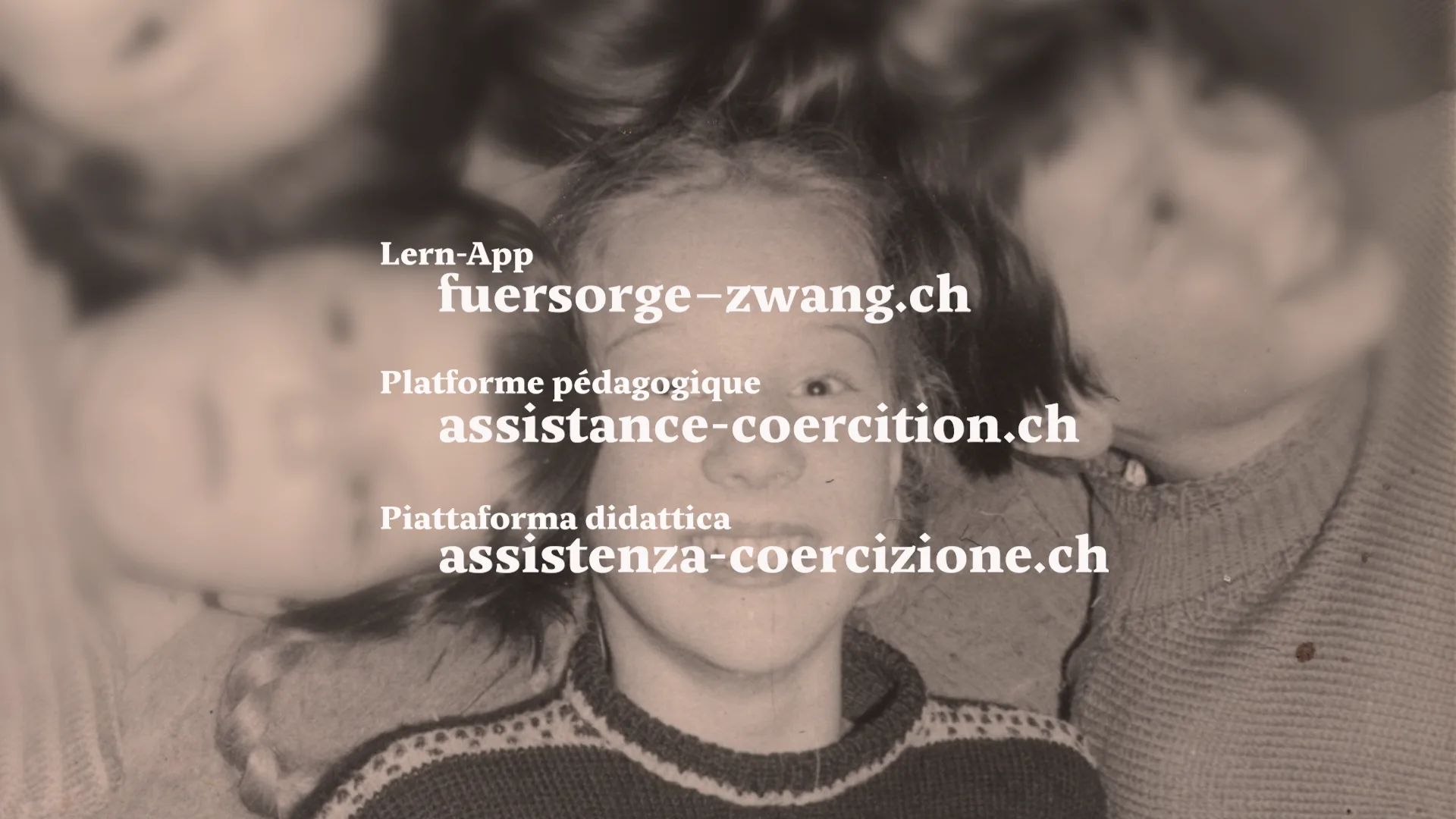
This web-based learning app is intended for schoolchildren in Year 7 and above, as well as anyone else who is interested. It is centred around the life stories of five people who experienced compulsory social measures and placements. Personal video testimonials, source material and reflections provide historical context. Learners can record their thoughts in a digital album and share their reflections, learning how the life stories of different people can unfold and how the wrongs that people suffered continue to have an impact today. The app is modular and free to use, and registration is not required. There are also classroom materials and a manual for instructors. The learning app was developed by the Lucerne University of Teacher Education in collaboration with the Universities of Teacher Education in Vaud and Ticino, the “Our Faces – Our Stories” Association and the Feinheit company.
FOSTERED, LOCKED AWAY, FORGOTTEN? The History and Stories of Compulsory Social Measures in Switzerland
The national touring exhibition “FOSTERED. LOCKED AWAY. FORGOTTEN?” sheds light on the history of compulsory social measures and placements in Switzerland, and how the country has come to terms with them. The exhibition brings this story to all regions of Switzerland. Lower and upper secondary school classes can participate in a guided educational programme in the form of a dialogue-based tour. Educational materials are also available to teachers for use in preparation for and follow-up after the exhibition visit.
“Ausgegrenzt und weggesperrt” [Shut out and locked away], an online programme
This online collection contains subject materials, files from contemporary witnesses, in-depth material and classroom instruction ideas. It is designed to help lower and upper secondary school teachers present the topic of “administrative detention” in a multifaceted and age-appropriate manner. The programme was jointly developed by the Independent Expert Commission (IEC) on Administrative Detention and the Bern University of Teacher Education.
Der Junge – historical novel
The fictitious historical novel was written by a team of researchers and classroom materials were developed for Cycle 3 of compulsory education, as well as for secondary school. The novel can be used as reading material in German or history classes.
School visits - Encounters with Contemporary Witnesses
The Erzählbistro [storytelling bistro] arranges visits to classrooms by contemporary witnesses. These visits enable direct dialogue between the witnesses and school classes, offering a unique and often emotional way of engaging with the issues. The contemporary witnesses are accompanies by a teacher who acts as a moderator. The Erzählbistro also organises trips to the Bern Cantonal Archives, where learners can explore the historical and political contexts of these issues.